

Eating the World, Creating Brazil: The Hidden Ingredient of Brazilian Cultural Expression
“His blood runs in my veins like a river of courage; I am the one who conquers time and makes the enemy a brother. His strength burns within me, and we become one, pulsing under the sky, like the flame that never goes out.” — Antônio Torres, Meu Querido Canibal
Artigo | por Rafael Medrado | Portuguese version
"Your blood runs in my veins like a river of courage; I am the one who conquers time and turns the enemy into a brother. His strength burns within me, and we become one, pulsing under the sky like a flame that never goes out." — Antônio Torres, Meu Querido Canibal
"Eat to become stronger, eat to be the other and, at the same time, be more of yourself." This phrase could have come from the heart of a manifesto or from within a Tupinambá village. In fact, it echoes from deep within the past, from the earliest stories Brazil told itself. When the German Hans Staden, a prisoner of the Tupinambás in the 16th century, observed the rituals of cannibalism and trembled at the thought of being devoured, he likely could not understand what it meant. Staden left us a precious account: an image that would shock Europe, and centuries later would be reinterpreted not as an act of barbarism, but as the beginning of an idea—the first seed of what would eventually become the philosophy of Brazilian Cultural Anthropophagy.
The Tupinambás ate their enemies because they believed that by consuming the flesh, they took on the strength and virtues of the other. This, to them, was part of a pact with the world, a dialogue between bodies, a dance between the living and the dead. Eat to absorb, eat to transform. And wasn’t that, after all, what Brazil did throughout its history? We swallowed the world, consumed influences, devoured cultures, and transformed everything into something new, something with the taste of sun and earth.
Hans Staden wrote Duas Viagens ao Brasil (1557), and the French theologian Jean de Léry wrote Viagem à Terra do Brasil (1578). There, among astonishment and perplexity, we find the embryo of the idea of anthropophagy. For the Europeans, it was cannibalism; for the Tupinambás, it was ritual and culture. The Tupinambá cannibalism frightened and fascinated, but it also planted an idea: a society that devours the other not out of hatred or hunger, but to create a fusion, a force.
I begin with the German’s work because it’s the only one I’ve read. Staden, with his foreign and astonished gaze, observed Brazil for the first time. An adventurer adrift, with a history marked by struggles on both the Portuguese and French sides, captured and imprisoned by the Tupinambás, he witnessed up close what seemed to be "cannibal terror" and transformed this fascination into words. He spent 9 months in captivity, under the condition of fighting for that ethnicity to pay off his sentence, and he came very close to being devoured. His book, Duas Viagens ao Brasil (1557), records the pain and enchantment of a world where, among other things, the ritual of eating the other was not just savagery—it was a form of assimilation, a fusion of bodies and spirits. A spectacle that lasted days, with a well-structured script and impactful performances. 2
Centuries later, during the refinement of the 19th century, Eduardo Prado—an aristocrat, major coffee producer in São Paulo, thinker, lover of literature, and founder of the Brazilian Academy of Letters—acquired an original edition of Staden's book. It wasn’t just a collector’s whim. At a time when Brazil sought to define its face, this edition became a symbol of resistance against the European cultural empire, a way of shouting that we, too, were made of other roots, that Europe did not have the monopoly on the Brazilian soul. Prado, a member of the intellectual elite, heir to a coffee fortune, was eager to rediscover what was Brazilian in ancient times and, together with the Brazilian Academy of Letters (ABL), began recording this "Becoming-Brazil."

Forty years later, Paulo Prado, Eduardo’s grand-nephew, grew up with this ancestral memory, an echo of civilized savagery that would accompany him to the 1922 Modern Art Week, which he helped fund. Paulo Prado would become the patron of a generation that carried the spark of transformation and revolt. The result of an incessant search for genuinely Brazilian artistic production, the Week was an irreverent shout, a desire to dismantle conventions, devour, hungrily, European influences, and drink from the rich broth of local roots. It was here that Oswald de Andrade raised his Manifesto Antropófago and introduced us to the idea that devouring was, in fact, the secret to survival. Instead of accepting external influences peacefully, it was necessary to digest them, to transform them. Or, as Oswald would say, "I’m only interested in what is not mine. The law of man. The law of the anthropophagist." Perhaps Brazil had always been a promise of anthropophagy. We just needed to take the first step and embrace the hunger. Let it exist. No wonder "Look, our food is jumping" was an iconic phrase frequently spoken among the circles of those tropical modernist intellectuals.
"What is ours, we do not want to deny; we want to swallow and transform." That was the essence of the Manifesto. Oswald proposed that, instead of rejecting external influence, Brazil should devour it and transform it. That was the birth of Cultural Anthropophagy—a philosophy based on "devouring to create." Brazil, Oswald said, does not reject; it incorporates, mixes, dilutes, transforms. Indigenous anthropophagy became a metaphor for cultural creation. Being Brazilian, after all, meant having the ability to absorb the other and produce something entirely new.
In literature, Mário de Andrade wrote Macunaíma, the hero with no character who is also all characters. "Little health and a lot of saúva, these are Brazil’s ills," the hero would say in one of his tricks. In Tarsila do Amaral, anthropophagy was transformed into color and form with Abaporu—the figure with enormous feet and a small head, the man who eats people and is devoured by Brazil’s thousand possibilities. It was as if, suddenly, Brazilianness emerged as a new rhythm, a body that dances with history, devouring the past and the future at the same time.
The concept of anthropophagy was far from being a modernist joke or a provocation from Oswald. Swiss anthropologist Alfred Métraux, a keen observer of indigenous cultures, demonstrated how complex this practice was among native peoples. His studies showed that cannibalism was not a spectacle of barbarism, but a ritual of encounter and incorporation—an act of communion, of appropriating what the other has most vital. It was more than a physical act; it was a philosophy that Oswald and his modernist companions reinterpreted, transforming it into a manifesto for a cultural identity capable of absorbing the world without losing itself in it.
In the 1950s, this anthropophagy was reflected in music. Bossa Nova was a way of embracing American jazz and returning it with a tropical smoothness. When João Gilberto sings Chega de Saudade, he reveals the spirit of a nostalgic and delicate Brazil, a saudade that is both light and deep: “Go, my sadness, and tell her that without her it cannot be.” Bossa was a subtle form of anthropophagy, a melody that absorbed the foreign and transformed it into something else, something the world would hear with eyes closed, feeling the warmth of a distant beach.
Then, in the 1960s, Tropicália would elevate anthropophagy to the level of protest, to the political scream. Caetano Veloso, Gal Costa, Gilberto Gil, and other tropicalists devoured psychedelic rock, popular music, samba, and whatever else they could find, to create a sound that was deeply Brazilian and, at the same time, global. In Tropicália, Caetano describes a mythical and real Brazil, complex and contradictory: “I organize the movement / I guide the carnival.” Tropicália, with its explosive blend, took cultural anthropophagy to a new frontier: Brazil not only devoured the other, but also devoured itself, reinventing itself with each new rhythm, each new influence.
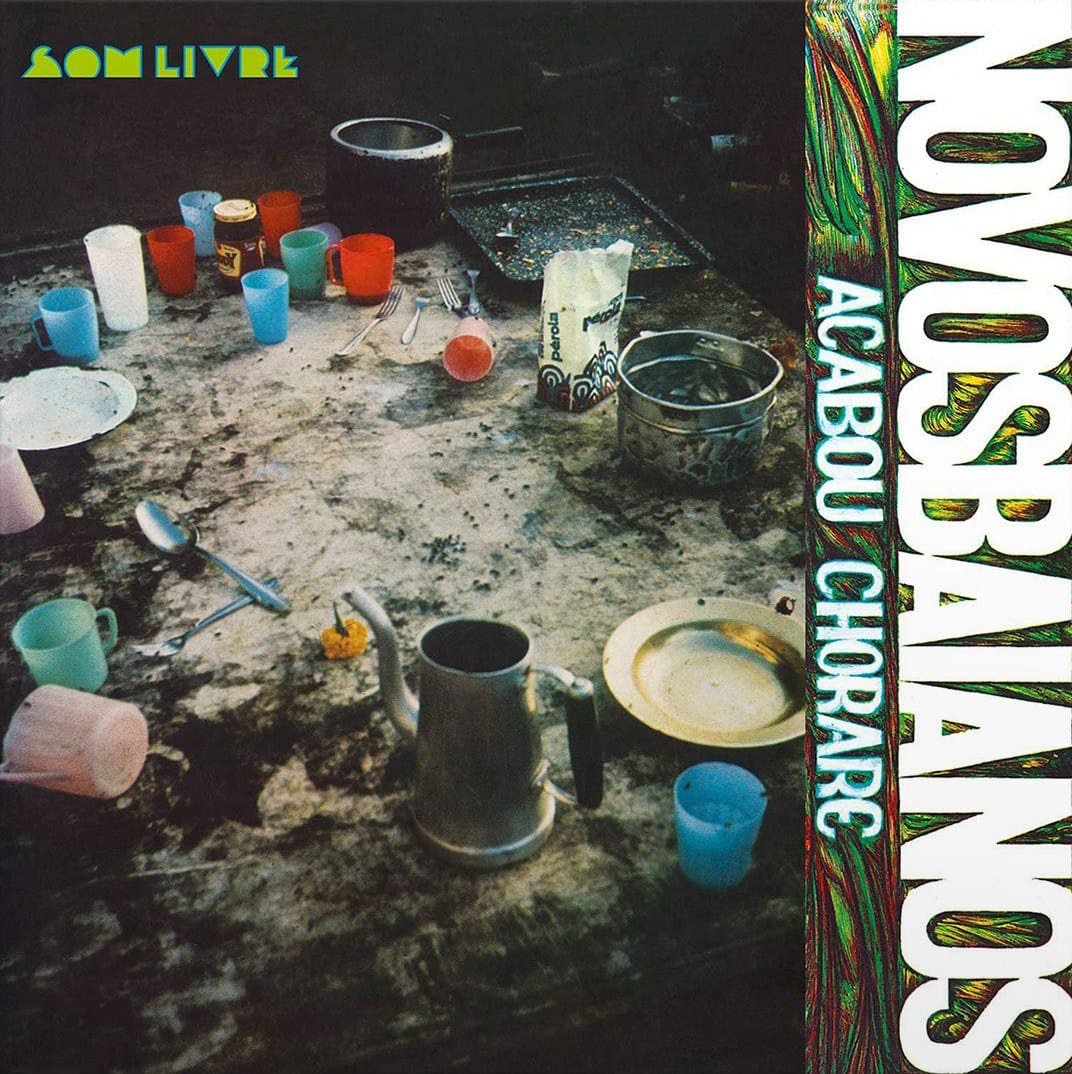
It is emblematic the account of Moraes Moreira about João Gilberto’s visit to the apartment of Novos Baianos when the group rented a penthouse in Ipanema, having recently emigrated from Bahia to Rio at the moment they were achieving national success. According to Moraes, beyond the shock of opening the door to that man, who in a brown suit and black tie looked more like an agent of the dictatorship in power at the time, João asked them to show him everything they knew, to display all the group’s musical virtuosity. In the end, he looked at them and said: “Everything is fine, but it lacks Brazil.”
At that moment, Novos Baianos were immersed in chords inspired by the new waves of international rock, with songs driven by lyrics that reflected the lightheartedness of Jovem Guarda and popular music of the time. However, the roots were missing — and João’s observation brought them back to the heart of that search.
And that was it: drawing from samba and baião, incorporating themes and instruments from Brazilian popular culture, and blending it all with the beats and chords of the electric guitar, Novos Baianos created the iconic album Acabou Chorare. A milestone of Brazilian identity, it fused the global and the local, the new and the traditional, reinventing Brazil’s very own sonic identity.
These expressions of Brazilian music and art demonstrate that the anthropophagic metaphor is not merely about mixing but about constant creation and continuous reinvention. Each artistic movement, each cultural expression, represents a new kind of hunger. And this hunger is never satisfied because brasilidade is this eternal appetite for the other — the ability to transform what is external into something that defines and expands us.
This insatiable hunger didn’t stop. In the 1990s, Recife’s Manguebeat movement, led by Chico Science, brought the spirit of Tropicália to the Northeast. In A Cidade, Chico sings about a harsh reality, a devouring city: “A cidade se apresenta centro das ambições / Para mendigos ou ricos e outras armações” (“The city presents itself as the center of ambitions / For beggars or the wealthy and other schemes”). It was as if Brazil were devouring itself to better understand its own essence.
Not to mention the perfect blend of past and future crafted by the lyrics and arrangements of Baiana System, who, in the 2010s, updated the entire tradition of musical anthropophagy. This is the spirit of anthropophagy: a fearless embrace of absorption and transformation. It’s an act of courage that carries both the risk and the promise of being something genuine and inherently mixed.
Cultural Anthropophagy: The Key to Our Identity
The concept of Cultural Anthropophagy is not just a beautiful idea—it defines the essence of modern Brazilian culture. It is the secret key behind our ability to create a unique identity without rejecting external influences. This is why Brazil can produce a Tom Jobim and a Glauber Rocha, a Tarsila do Amaral and a Hélio Oiticica, a Tropicália and a Bossa Nova. In all these expressions, we see the capacity to devour the other and recreate it in an original way.
By embracing cultural anthropophagy, Brazilian culture becomes universal without losing its authenticity. We are mixed not only in blood but in soul, in aesthetics, in sound. Devouring the other is our way of existing. Transforming is our way of creating. Cultural anthropophagy has taught us to look at the world, to absorb everything it has to offer, and to turn it into a new way of being—a new art, a new music, a new poetry.
In the interweaving of voices, rhythms, and colors, Brazil is a body that pulses and expands, a skin that absorbs and reflects, unmaking and remaking itself, eternal and fleeting, dancing on the edge of the new and the ancestral. It is an identity built from pieces of the world, a living mosaic that draws strength not from borders but from embraces; not from what it rejects, but from what it devours, transforms, and returns. It is the jungle and the city, the drumbeat and the silence, the crack where the light enters, always making room for more stories, more sounds, more dreams.
This unique identity is strengthened not by everything it is not, but by everything it can be.
And it keeps on being—just like Gil's Rio de Janeiro.
1. Both can be found in PDF format and are easily accessible through a quick internet search. ↩︎
2. Hans Staden's account of the Tupinambás arrived in Europe like a bombshell in the second half of the 16th century. The publication of his book coincided with the flourishing of Renaissance and Humanist ideas that would redefine the understanding of humanity and society, such as Thomas More’s Utopia (1516), Niccolò Machiavelli’s The Prince (1532), and Montaigne’s Essays (1580). ↩︎

Foto: Flora Negri
Rafael Medrado é ator, produtor e pesquisador das Artes Performativas, com formação pela Escola Superior de Teatro e Cinema de Lisboa. Com uma trajetória que abrange o teatro, o cinema e a televisão, Rafael construiu uma percurso internacional, atuando no Brasil, em Portugal e em outros países.
Além de seu trabalho como artista, dedica-se à reflexão sobre temas como arte, cultura, filosofia, política e comportamento, compartilhando suas ideias em cursos, palestras e no blog Entre Outras Coisas.
RADAR BOSSA FM
Quer ficar por dentro dos últimos lançamentos da música brasileira?
Siga a playlist Radar Bossa FM no Spotify.

Comer o Mundo, Criar o Brasil: O Ingrediente Oculto da Expressão Cultural Brasileira
“Seu sangue corre em minha veia como um rio de coragem; eu sou aquele que vence o tempo e faz do inimigo, irmão. Queima em mim a força dele, e nos tornamos um só, pulsando sob o céu, como a chama que nunca se apaga.” — Antônio Torres, Meu Querido Canibal
Artigo | por Rafael Medrado | English version
“Seu sangue corre em minha veia como um rio de coragem; eu sou aquele que vence o tempo e faz do inimigo, irmão. Queima em mim a força dele, e nos tornamos um só, pulsando sob o céu, como a chama que nunca se apaga.” — Antônio Torres, Meu Querido Canibal
“Comer para se tornar mais forte, comer para ser o outro e, ao mesmo tempo, ser mais de si.” A frase poderia ter saído do coração de um manifesto ou do interior de uma aldeia Tupinambá. Na verdade, ela ecoa lá de trás, das primeiras histórias que o Brasil contou a si mesmo. Quando o alemão Hans Staden, prisioneiro dos Tupinambás no século XVI, observava os rituais de antropofagia e tremia ao ver-se quase devorado, ele provavelmente não conseguia entender o que aquilo significava. Staden nos legou um relato precioso: uma imagem que chocaria a Europa e, séculos depois, seria reinterpretada não como um ato de barbárie, mas como o início de uma ideia — a primeira semente do que, com o tempo, se tornaria a filosofia da Antropofagia Cultural Brasileira.
Os Tupinambás comiam seus inimigos porque acreditavam que, ao devorar a carne, tomavam para si a força e as virtudes do outro. Algo que, para eles, era parte de um pacto com o mundo, um diálogo entre corpos, uma dança entre vivos e mortos. Comer para absorver, comer para transformar. E não foi isso, afinal, o que o Brasil fez ao longo de sua história? Engolimos o mundo, comemos influências, devoramos culturas, e transformamos tudo em algo novo, algo com gosto de sol e terra.
Hans Staden escreveu Duas Viagens ao Brasil (1557), e o teólogo francês Jean de Léry escreveu Viagem à Terra do Brasil (1578). 1 Ali, entre espantos e perplexidades, encontramos o embrião da ideia de antropofagia. Para os europeus, aquilo era canibalismo; para os Tupinambás, era ritual e cultura. O canibalismo Tupinambá assustava e fascinava, mas também plantava uma ideia: uma sociedade que devora o outro não por ódio ou fome, mas para criar uma fusão, uma força.
Começo pela obra do alemão porque foi a única que li. Staden, com seu olhar estrangeiro e espantado, observou o Brasil pela primeira vez. Um aventureiro à deriva, com um trajetória maracada por lutas ora do lados dos portugueses ora dos franceses, capturado e preso pelos tupinambás, viu de perto o que parecia ser o “terror canibal” e transformou esse fascínio em palavras. Ficou 9 meses preso, sob a condição de lutar a favor daquela etnia para pagar sua pena e por muito pouco não foi devorado. Seu livro, Duas Viagens ao Brasil (1557), registra a dor e o encantamento de um mundo onde, entre outras coisas, o ritual de comer o outro não era só selvageria — era uma forma de assimilação, uma fusão de corpos e espíritos. Um espetáculo que durava dias, com roteiro bem estruturado e performances impactantes. 2
Séculos depois, em meio ao refinamento do século XIX, Eduardo Prado — aristocrata, grande produtor de café em São Paulo, pensador, amante das letras e fundador da Academia Brasileira de Letras — adquiriu uma edição original do livro de Staden. Não foi apenas um capricho de colecionador. Em uma época em que o Brasil buscava definir sua face, essa edição era um emblema de resistência contra o império cultural europeu, uma forma de gritar que também éramos feitos de outras raízes, que a Europa não tinha o monopólio da alma brasileira. Prado, membro de uma elite intelectual, herdeiro de uma fortuna cafeeira, tinha sede de redescobrir o que era brasileiro nos tempos ancestrais e, junto com a ABL, deu início aos registros deste “Devir-Brasil”.
Quarenta anos mais tarde, Paulo Prado, sobrinho-neto de Eduardo, cresceria com essa memória ancestral, um eco de selvageria civilizada que o acompanharia até a Semana de Arte Moderna de 1922, que ele ajudou a financiar. Paulo Prado se tornaria o mecenas de uma geração que carregava em si a faísca da transformação e da revolta. Resultado de busca incessante por uma produção artística genuinamente brasileira, a Semana foi um grito irreverente, um desejo de desmontar as convenções, devorar, com fome, as influências europeias e beber do grosso caldo das raízes locais. Foi aí que Oswald de Andrade ergueu seu Manifesto Antropófago e nos apresentou à ideia de que devorar era, na verdade, o segredo para sobreviver. Em vez de aceitar pacificamente as influências, era preciso digeri-las, transformá-las. Ou, como Oswald diria, “só me interessa o que não é meu. Lei do homem. Lei do antropófago”. Talvez o Brasil fosse sempre uma promessa de antropofagia. Só precisávamos dar o primeiro passo e assumir a fome. Deixá-la existir . Não à toa “Olha aí a nossa comida pulando” era frase icónica frequentemente pronunciada entre os círculos daquele intelectuais modernistas tropicais.
“O que é nosso não queremos negar, queremos engolir e transformar.” Era essa a essência do Manifesto. Oswald propôs que, em vez de rejeitar a influência externa, o Brasil deveria devorá-la e transformá-la. Nascia aí a Antropofagia Cultural — uma filosofia que se baseia no “devorar para criar”. O Brasil, dizia Oswald, não rejeita, ele incorpora, mistura, dilui, transforma. A antropofagia indígena virou metáfora para a criação cultural. Ser brasileiro, afinal, era ter a capacidade de absorver o outro e produzir algo inteiramente novo.
Na literatura, Mário de Andrade escreveria Macunaíma, o herói sem nenhum caráter que é também todos os caracteres. “Pouca saúde e muita saúva, os males do Brasil são”, diria o herói numa de suas travessuras. Em Tarsila do Amaral, a antropofagia se transformava em cor e forma com o Abaporu — a figura de pés enormes e cabeça pequena, esse homem que come gente e que é devorado pelo Brasil de mil possibilidades. Era como se, de repente, a brasilidade surgisse como um ritmo novo, como um corpo que dança com a história, devorando o passado e o futuro ao mesmo tempo.
O conceito de antropofagia estava longe de ser brincadeira modernista ou uma provocação de Oswald. O antropólogo suíço Alfred Métraux, um observador atento das culturas indígenas, mostrou o quão complexa era essa prática entre os povos originários. Seus estudos de que o canibalismo não era um espetáculo de barbárie, mas um ritual de encontro e incorporação. Um ato de comunhão, de apropriação do que o outro tem de mais vital. Era mais do que um ato físico — era uma filosofia que Oswald e seus companheiros modernistas reinterpretaram, transformando em manifesto de uma identidade cultural capaz de absorver o mundo sem perder-se nele.
Nos anos 1950, essa antropofagia se refletiu na música. A Bossa Nova foi um jeito de abraçar o jazz americano e devolvê-lo com uma suavidade tropical. Quando João Gilberto canta Chega de Saudade, ele revela o espírito de um Brasil nostálgico e delicado, uma saudade que é ao mesmo tempo leve e profunda: “Vai, minha tristeza, e diz a ela que sem ela não pode ser.” A bossa era uma antropofagia sutil, uma melodia que absorvia o estrangeiro e transformava em outra coisa, algo que o mundo ouviria com olhos fechados, sentindo o calor de uma praia distante.
Depois, nos anos 1960, a Tropicália elevaria a antropofagia ao nível da contestação, do grito político. Caetano Veloso, Gal Costa, Gilberto Gil e outros tropicalistas devoraram o rock psicodélico, a música popular, o samba e o que mais houvesse, para criar um som que era profundamente brasileiro e, ao mesmo tempo, mundial. Em Tropicália, Caetano descreve um Brasil mítico e real, complexo e contraditório: “Eu organizo o movimento / Eu oriento o carnaval.” A Tropicália, com sua mistura explosiva, levou a antropofagia cultural a uma nova fronteira: o Brasil não apenas devorava o outro, mas também se devorava, reinventando-se com cada novo ritmo, cada nova influência.
É emblemático o relato de Moraes Moreira sobre a visita de João Gilberto ao apartamento dos Novos Baianos, quando o grupo alugou uma cobertura em Ipanema, recém-emigrados da Bahia para o Rio, no momento em que alcançavam sucesso nacional. Segundo Moraes, além do susto de receberem à porta aquele homem que, de terno castanho e gravata preta, mais parecia um agente da ditadura que vigorava na época, João pediu que mostrassem tudo o que sabiam, que exibissem todo o virtuosismo musical do grupo. Ao final, ele os olhou e disse: “Está tudo certo, mas falta Brasil.”
Naquele momento, os Novos Baianos estavam imersos em acordes inspirados pelos novos movimentos do rock internacional, com canções embaladas por letras que traziam a leveza da Jovem Guarda e da música popular da época. Contudo, faltava a raiz — e a observação de João os colocou de volta ao centro dessa busca.
Não deu outra: bebendo do samba, do baião, incorporando temas e instrumentos da cultura popular brasileira e mesclando tudo com as batidas e acordes da guitarra elétrica, os Novos Baianos deram origem ao icônico álbum Acabou Chorare, um marco de brasilidade que misturou o mundo e a terra, o novo e o tradicional, reinventando a própria identidade sonora do Brasil.
Essas expressões da música e da arte brasileira mostram como a metáfora antropofágica não se trata apenas de mistura, mas de uma criação constante, uma reinvenção contínua. Cada movimento artístico, cada expressão cultural é um novo tipo de fome. E essa fome não se sacia, porque a brasilidade é esse eterno apetite pelo outro, essa capacidade de transformar o que é externo em algo que nos define e nos amplia.
Essa fome insaciável não parou. Nos anos 1990, o Manguebeat do Recife, com Chico Science, trouxe o espírito da Tropicália para o Nordeste. Em A Cidade, Chico canta sobre uma realidade dura, uma cidade devoradora: “A cidade se apresenta centro das ambições / Para mendigos ou ricos e outras armações.” Era como se o Brasil devorasse o próprio Brasil para se entender melhor. Isto para não deixar de citar a mistura perfeita entre passado e futuro feita pelas letras e arranjos do Baiana System, atualizando toda a atropofagia musical no idos de 2010. Esse é o espírito antropofágico: não há medo de absorver, de transformar. É um ato de coragem que carrega o risco e a promessa de ser algo genuíno e mestiço.
Antropofagia Cultural: A Chave da Nossa Identidade
O conceito de Antropofagia Cultural não é apenas uma ideia bonita. Ele define a essência da cultura brasileira moderna. É a chave secreta por trás da nossa capacidade de criar uma identidade única sem negar as influências externas. É por isso que o Brasil pode produzir um Tom Jobim e um Glauber Rocha, uma Tarsila do Amaral e um Hélio Oiticica, uma Tropicália e uma Bossa Nova. Em todas essas expressões, vemos a capacidade de devorar o outro e recriá-lo de forma original.
Ao abraçar a antropofagia cultural, a cultura brasileira se torna universal sem perder a autenticidade. Somos mestiços não só no sangue, mas na alma, na estética, no som. Comer o outro é nossa forma de existir. Transformar é nossa maneira de criar. A antropofagia cultural nos ensinou a olhar o mundo, a absorver tudo o que ele tem a oferecer e a fazer disso uma nova forma de ser, uma nova arte, uma nova música, uma nova poesia.
No entrelaçamento de vozes, ritmos e cores, o Brasil é um corpo que pulsa e expande, uma pele que absorve e devolve, se desfaz e se refaz, eterno e fugaz, dançando à beira do novo e do ancestral. É uma identidade feita de pedaços do mundo, um mosaico vivo que se fortalece não nas fronteiras, mas nos abraços; não pelo que rejeita, mas pelo que devora, transforma e devolve. É a selva e a cidade, o batuque e o silêncio, a fresta por onde entra a luz e onde sempre cabem mais histórias, mais sons, mais sonhos.
Esta identidade única, fortalecida não por tudo aquilo que ela não é, mas por tudo que ela pode ser.
E continua sendo. Tal qual o Rio de Janeiro de Gil.
Ambos encontram-se em PDF e é possível encontrá-los numa rápida pesquisa na internet. ↩︎
O relato de Hans Staden sobre os Tupinambás chega como uma bomba à Europa na segunda metade do século XVI. A publicação de seu livro coincide com o florescimento de ideias renascentistas e humanistas que redefiniriam a compreensão do homem e da sociedade como: Thomas More, com a sua Utopia (1516); Nicolau Maquiavel, com O Príncipe (1532); e Montaigne, em seus Ensaios (1580). ↩︎
Foto: Flora Negri
Rafael Medrado é ator, produtor e pesquisador das Artes Performativas, com formação pela Escola Superior de Teatro e Cinema de Lisboa. Com uma trajetória que abrange o teatro, o cinema e a televisão, Rafael construiu uma percurso internacional, atuando no Brasil, em Portugal e em outros países.
Além de seu trabalho como artista, dedica-se à reflexão sobre temas como arte, cultura, filosofia, política e comportamento, compartilhando suas ideias em cursos, palestras e no blog Entre Outras Coisas.